<?xml version="1.0" encoding="utf-8"?><feed xmlns="http://www.w3.org/2005/Atom" ><generator uri="https://jekyllrb.com/" version="3.10.0">Jekyll</generator><link href="https://smarianimore.github.io/feed.xml" rel="self" type="application/atom+xml" /><link href="https://smarianimore.github.io/" rel="alternate" type="text/html" /><updated>2026-07-21T16:08:33+02:00</updated><id>https://smarianimore.github.io/feed.xml</id><title type="html">Stefano Mariani’s website</title><subtitle>Computer science, engineering, raising kids, dinosaurs, videogames, and whatever else according to Stefano Mariani&apos;s perspective :)</subtitle><author><name>Stefano Mariani</name></author><entry><title type="html">Salvo’s paper at ICAART now available :)</title><link href="https://smarianimore.github.io/2026/04/25/icaart-salvo.html" rel="alternate" type="text/html" title="Salvo’s paper at ICAART now available :)" /><published>2026-04-25T00:00:00+02:00</published><updated>2026-04-25T00:00:00+02:00</updated><id>https://smarianimore.github.io/2026/04/25/icaart-salvo</id><content type="html" xml:base="https://smarianimore.github.io/2026/04/25/icaart-salvo.html"><![CDATA[<p>Dear fellow researchers, the paper that <a href="https://www.linkedin.com/in/salvo-finistrella-03083540/">Salvo Finistrella</a>, 
brilliant PhD student collaborating with me and <a href="http://www.agentgroup.unimore.it/Zambonelli/">Franco Zambonelli</a>, 
published at <a href="https://icaart.scitevents.org/?y=2026">ICAART 2026</a> is now available :)</p>

<p>Check it out <a href="https://www.scitepress.org/Link.aspx?doi=10.5220/0014300900004052">here</a>.</p>

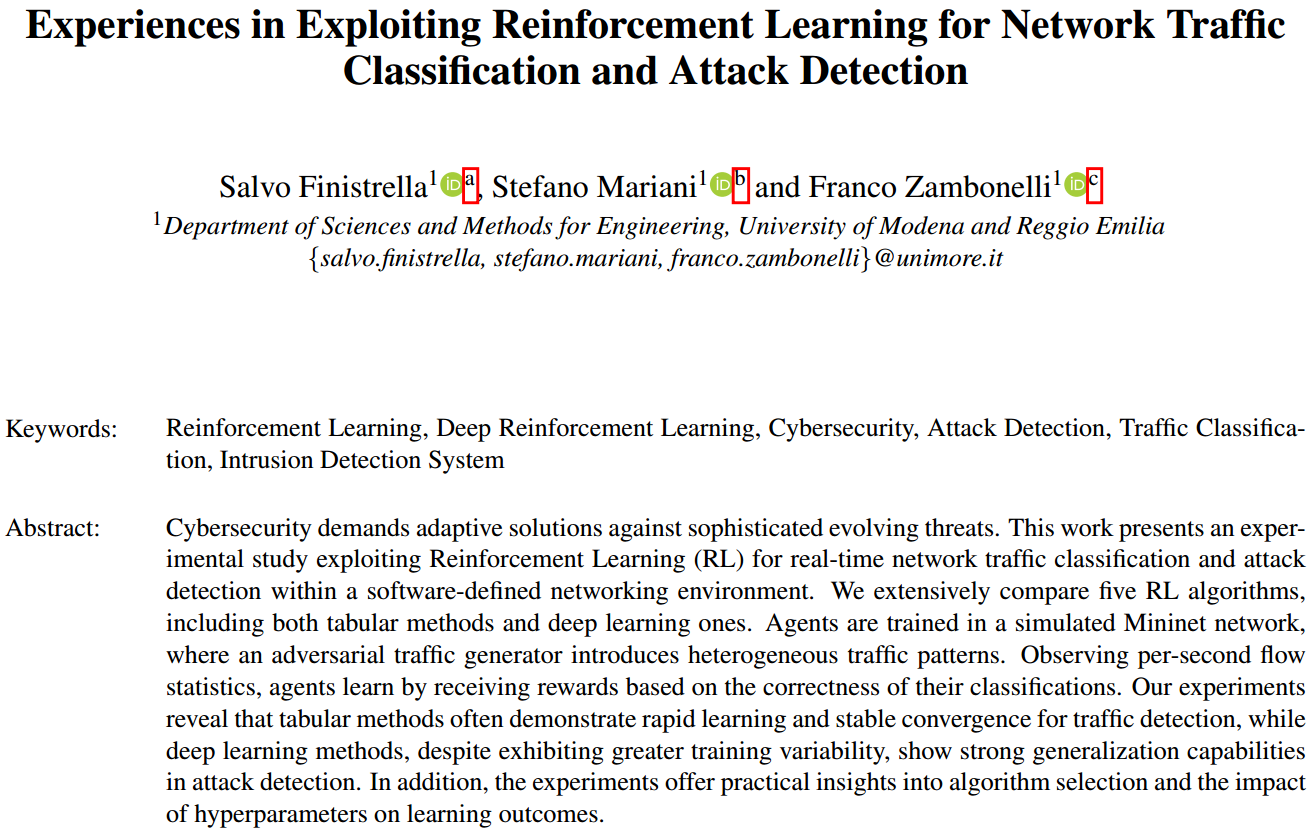
<p><img src="https://smarianimore.github.io/assets/2026-icaart-salvo-glance.png" alt="image-center" class="align-center" /></p>

<p>In that paper, Salvo put to test his own brand new simulator <a href="https://www.sciencedirect.com/science/article/pii/S235271102500278X">MininetGym</a>, 
by comparing tabular and deep RL algorithms on two cybersecurity tasks.</p>

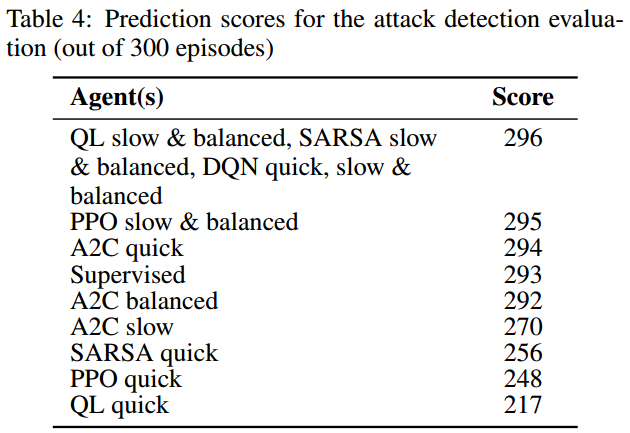
<p><img src="https://smarianimore.github.io/assets/2026-icaart-salvo-eval-detection.png" alt="image-center" class="align-center" /></p>

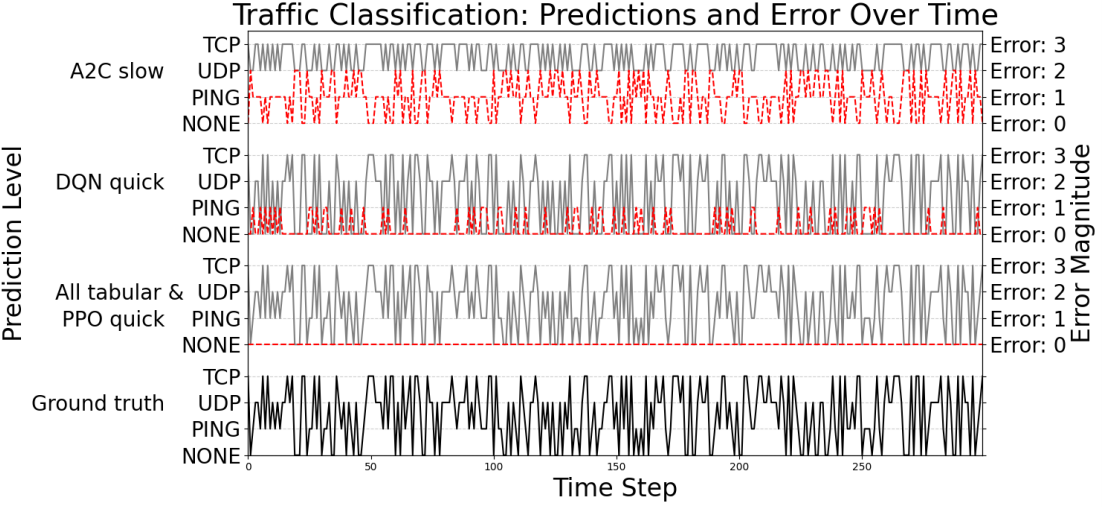
<p>In particular, he also analysed the kind of errors that the learnt policies made, 
so as to provide a practically usable assessment of RL capabilities within the cybersecurity domain.</p>

<p><img src="https://smarianimore.github.io/assets/2026-icaart-salvo-errors.png" alt="image-center" class="align-center" /></p>

<p>Finally, Salvo summarised the main takeaway lessons learned:</p>

<ul>
  <li>✅ Traffic classification and attack detection can be dealt with by RL</li>
  <li>📉 Better training performance does not necessarily correlate to better generalisation</li>
  <li>⚖️ Reward design should carefully balance false alarms with missed threats</li>
</ul>

<p>Feel free to <a href="mailto:stefano.mariani@unimore.it">contact me</a> for a pre-print, any inquiry, or even better <strong>to join us</strong> in this research :)</p>

<p>Peace.</p>]]></content><author><name>Stefano Mariani</name></author><category term="ICAART 2026" /><category term="reinforcement learning" /><category term="cybersecurity" /><category term="attack detections" /><category term="traffic classification" /><category term="publication" /></entry><entry><title type="html">Giovanni’s best paper at AREA (ECAI workshop) :)</title><link href="https://smarianimore.github.io/2025/10/25/area-best-giovanni.html" rel="alternate" type="text/html" title="Giovanni’s best paper at AREA (ECAI workshop) :)" /><published>2025-10-25T00:00:00+02:00</published><updated>2025-10-25T00:00:00+02:00</updated><id>https://smarianimore.github.io/2025/10/25/area-best-giovanni</id><content type="html" xml:base="https://smarianimore.github.io/2025/10/25/area-best-giovanni.html"><![CDATA[<p>Dear fellow researchers, <a href="https://ecai2025.org/">ECAI’25 just concluded</a>, and with it also its workshops, too. 
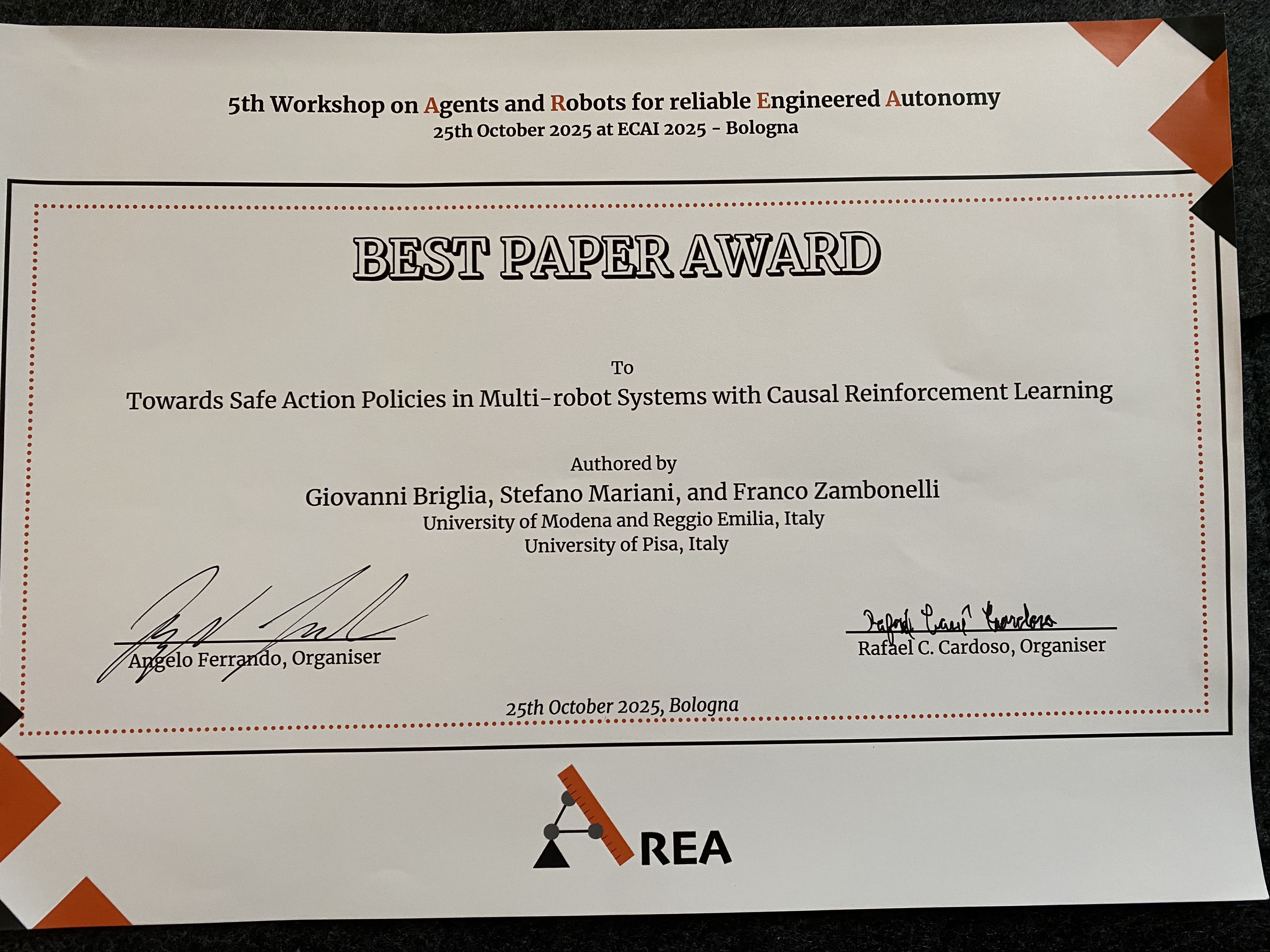
At the workshop <a href="https://areaworkshop.github.io/AREA2025/">AREA</a>, <a href="https://giovannibriglia.github.io/">Giovanni Briglia</a> (and we co-authors, too) had a very nice surprise: his very first <strong>best paper award</strong> :) Of course, we hope that’s just the start for him 🚀</p>

<p><img src="https://smarianimore.github.io/assets/giovanni-ecai-best-rotated.jpeg" alt="image-center" class="align-center" /></p>

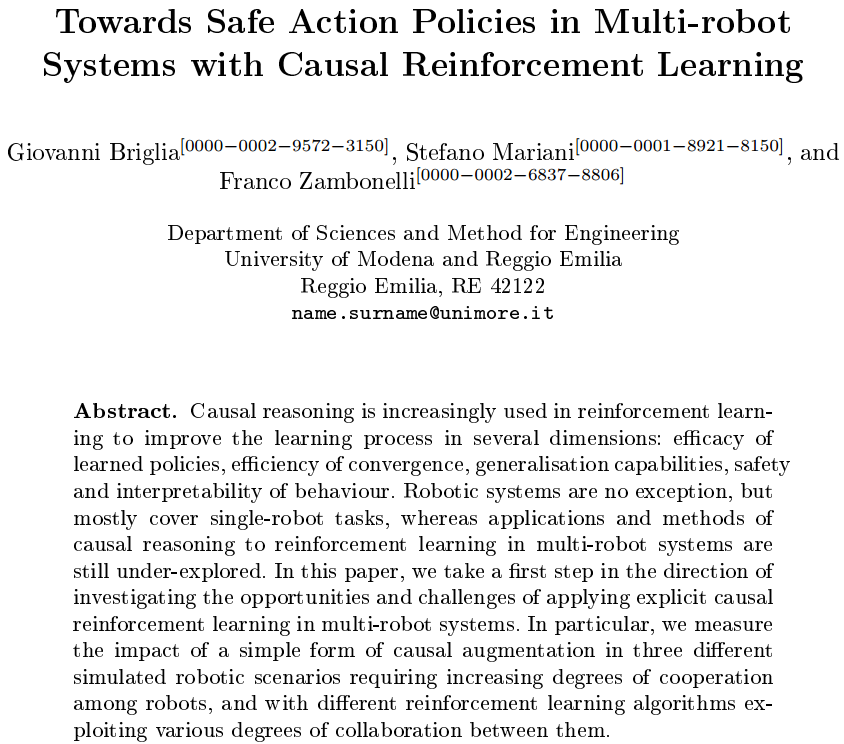
<p>Giovanni presented the following paper about <strong>causal multi-agent reinforcement learning</strong> applied to multi-robot systems (📖 <a href="https://link.springer.com/chapter/10.1007/978-3-032-08049-3_4">proceedings here</a>):</p>

<p><img src="https://smarianimore.github.io/assets/2025-area-abstract.png" alt="image-center" class="align-center" /></p>

<p>When it comes to multi-robot systems (MRS) 🤖, Reinforcement Learning (RL) faces a few challenges, among which is the risk of performing dangerous actions and learn unsafe policies.
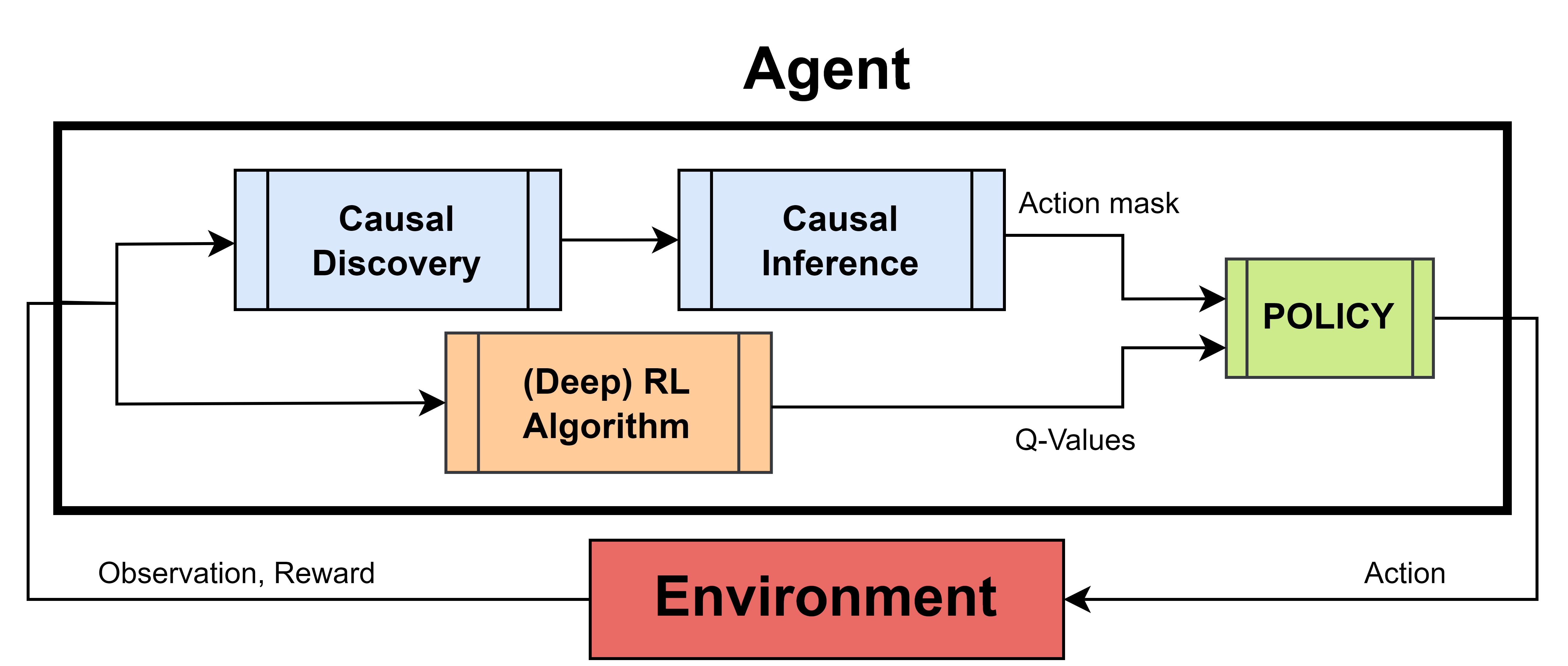
Hence, we augmented standard RL algorithms with <strong>causal discovery and inference</strong> 🔍, enabling robots to: 🚫 Avoid risky actions and 🧭 Predict outcomes more reliably :)</p>

<p>On purpose, we designed a modular causal augmentation pipeline that:</p>

<ul>
  <li>📊 <strong>Learns a core causal model</strong> from robot-environment interactions</li>
  <li>🧮 Uses causal inference to filter unsafe or suboptimal actions</li>
  <li>🧠 Integrates seamlessly with popular RL algorithms like IQL, VDN, and Qmix</li>
</ul>

<p><img src="https://smarianimore.github.io/assets/causal_rl_frameworks.png" alt="image-center" class="align-center" /></p>

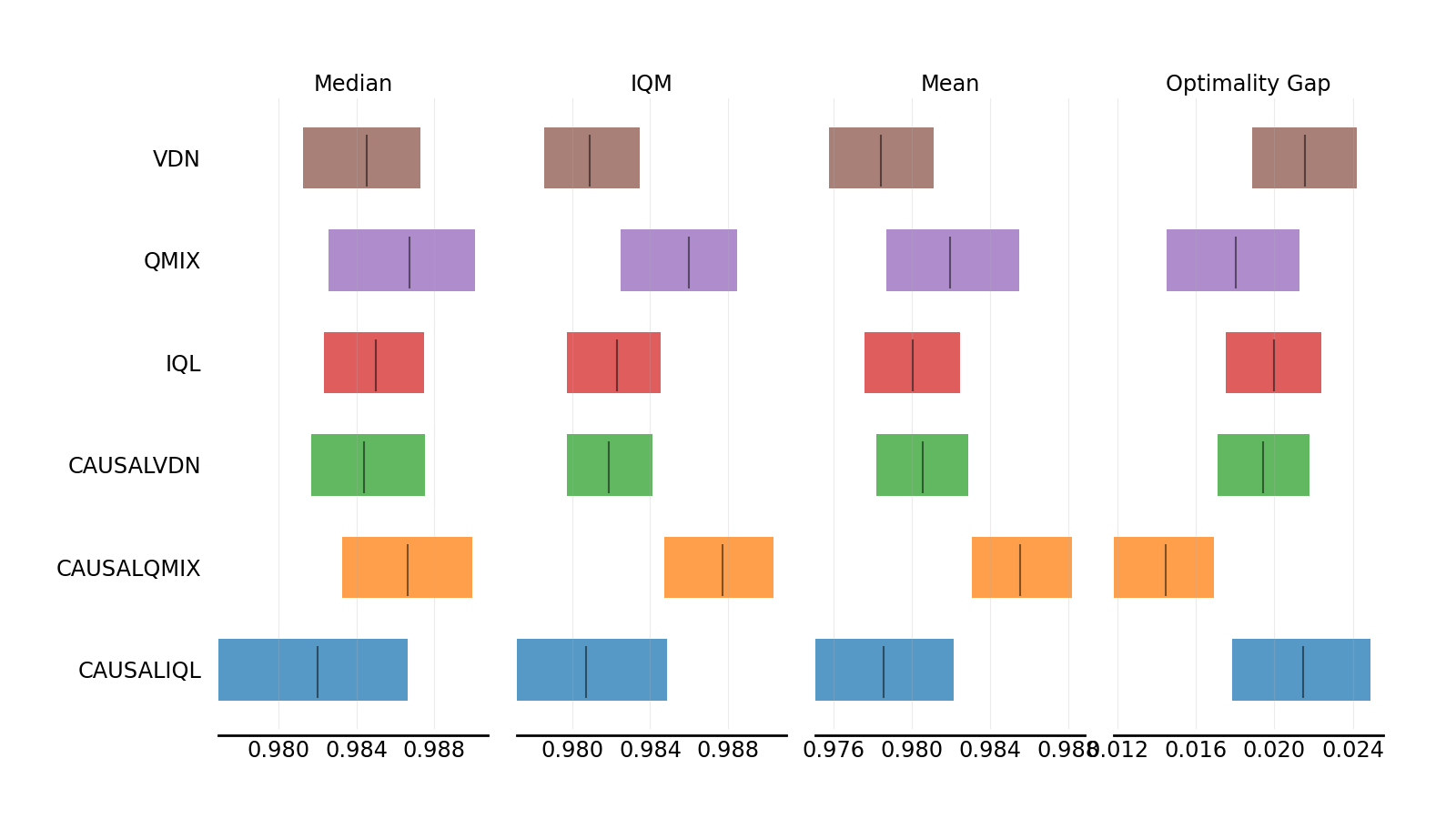
<p>By testing on the 🧭 Navigation, 🐦 Flocking, and🚦 Give-Way scenarios taken from the <a href="https://github.com/proroklab/VectorizedMultiAgentSimulator">VMAS simulator</a>, we observed three key results:</p>

<ul>
  <li>✅ Improved safety: Fewer risky actions and collisions</li>
  <li>📉 Reduced variance in performance</li>
  <li>⚖️ Mixed outcomes depending on task complexity and algorithm cooperation level</li>
</ul>

<p><img src="https://smarianimore.github.io/assets/complete_aggregate_scores.png" alt="image-center" class="align-center" /></p>

<p>The takeaway message is that <strong>causal learning and reasoning</strong> can enhance safety and performance in MRS, but that <strong>collaborative causal discovery</strong> is likely to unlock even better results!</p>

<p>Feel free to <a href="mailto:stefano.mariani@unimore.it">contact me</a> for a pre-print, any inquiry, or even better <strong>to join us</strong> in this research :)
📂 Code &amp; experiments: <a href="https://github.com/Giovannibriglia/CausalBenchMARL">https://github.com/Giovannibriglia/CausalBenchMARL</a></p>

<p>Peace.</p>]]></content><author><name>Stefano Mariani</name></author><category term="AREA2025" /><category term="multi-agent causal reinforcement learning" /><category term="multi-agent reinforcement learning" /><category term="structural causal models" /><category term="multi-agent systems" /><category term="publication" /></entry><entry><title type="html">First paper by Davide Borghi :)</title><link href="https://smarianimore.github.io/2025/06/09/paper-discoli-davide.html" rel="alternate" type="text/html" title="First paper by Davide Borghi :)" /><published>2025-06-09T00:00:00+02:00</published><updated>2025-06-09T00:00:00+02:00</updated><id>https://smarianimore.github.io/2025/06/09/paper-discoli-davide</id><content type="html" xml:base="https://smarianimore.github.io/2025/06/09/paper-discoli-davide.html"><![CDATA[<p>Dear fellow researchers, <a href="https://www.linkedin.com/posts/claudio-savaglio-93870063_lucca-discoli-dcoss-activity-7339969773104943104-5xF0?utm_source=share&amp;utm_medium=member_desktop&amp;rcm=ACoAAAzy1fUBs7hKcdd5DFPhk8ePf5E0KdYraAQ">DISCOLI’25 just concluded</a>, and it was a very special event to attend for at least one person: <a href="https://www.linkedin.com/in/davide-borghi-72ba81190/">Davide Borghi</a>, who presented his very first scientific paper :)</p>

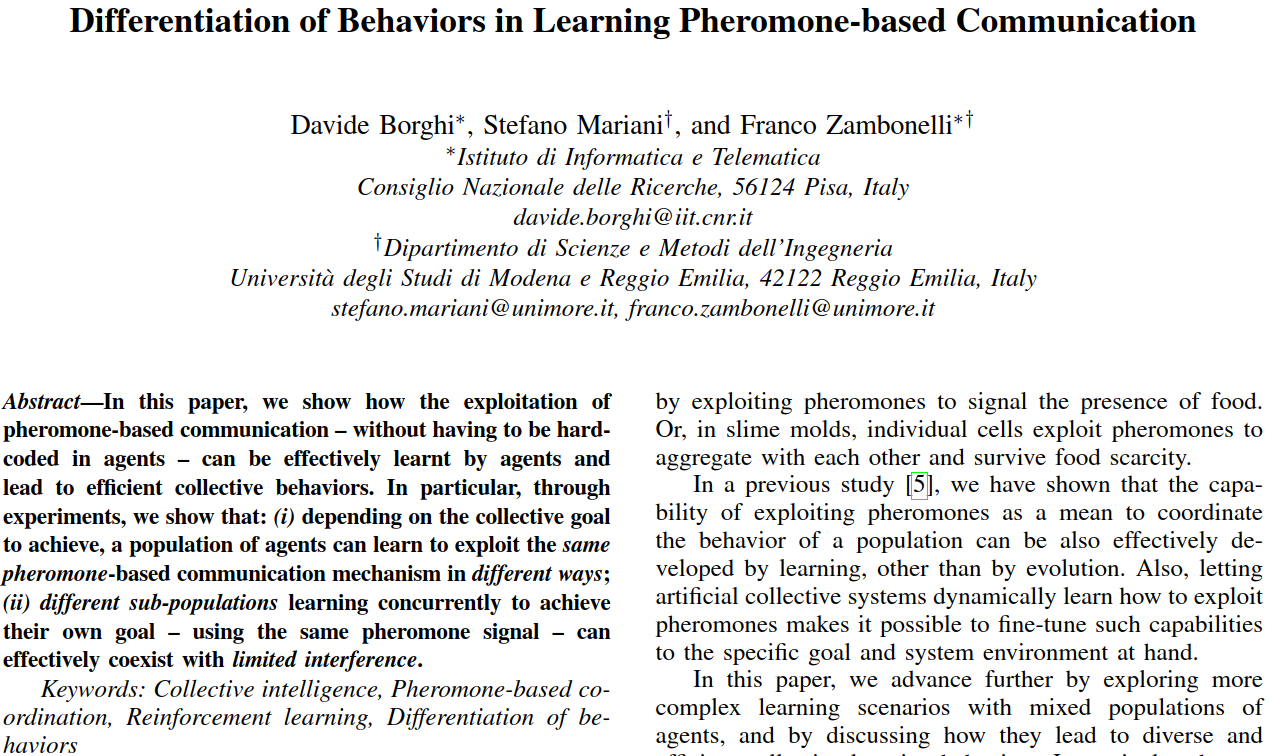
<p>Davide is a research fellow at the <a href="https://www.iit.cnr.it/en/about-us/">Institute of Informatics and Telematics</a> of the National Research Council that collaborates with me and <a href="http://www.agentgroup.unimore.it/Zambonelli/">Franco Zambonelli</a> on <strong>learning communication policies in artificial swarms</strong>.</p>

<p><img src="https://smarianimore.github.io/assets/talks/discoli2025-rl-swarms-title.png" alt="image-center" class="align-center" /></p>

<p>His work – slides are freely available <a href="https://shorturl.at/th6xl">here</a>, proceedings are in press – advances a previous work by me and Franco (<a href="https://smarianimore.github.io/2023/09/19/paper-acsos2023.html">here</a>) that investigated whether and how individuals in a <strong>swarm</strong> can <strong>learn communication policies</strong> to achieve a goal requiring <strong>collective intelligence</strong>.</p>

<p>While we proved that such communication policies can be learnt and that the learnt policies are also more efficient than hard-coded ones, 
Davide further advanced by proving that individuals can learn to exploit the <strong>same communication signal for different purposes</strong>, 
even in mixed populations!</p>

<p><img src="https://smarianimore.github.io/assets/talks/Action_freq.png" alt="image-center" class="align-center" /></p>

<p>This means that the learning process and the convergence policies are <strong>robust to the noise</strong> generated by heterogeneous agents in the population.</p>

<p>Feel free to <a href="mailto:stefano.mariani@unimore.it">contact me</a> for a pre-print, any inquiry, or even better <strong>to join us</strong> in this research :)</p>

<p>Peace.</p>]]></content><author><name>Stefano Mariani</name></author><category term="DISCOLI2025" /><category term="pheromone-based communication" /><category term="multi-agent reinforcement learning" /><category term="swarm intelligence" /><category term="learning to communicate" /><category term="coordination" /><category term="publication" /></entry><entry><title type="html">Confused about Digital Twins and their role in AI? Be no more!</title><link href="https://smarianimore.github.io/2025/03/11/paper-DTAA.html" rel="alternate" type="text/html" title="Confused about Digital Twins and their role in AI? Be no more!" /><published>2025-03-11T00:00:00+01:00</published><updated>2025-03-11T00:00:00+01:00</updated><id>https://smarianimore.github.io/2025/03/11/paper-DTAA</id><content type="html" xml:base="https://smarianimore.github.io/2025/03/11/paper-DTAA.html"><![CDATA[<p>Are you <strong>confused</strong> about <strong>Digital Twins</strong> and their role in <strong>AI</strong>? 
Are they “reinventing the wheel” with a brand new name, or not? 
They seem to have a notable overlap with <strong>Autonomous Agents</strong> (the “software engineering” ones, not the modern LLM-like crap…), is it true?</p>

<p>Well, if you are confused about the above, 
and in general about the role of these two abstractions and technologies (DTs and AAs) in modern AI, 
<em>WE GOT YOU COVERED :)</em></p>

<p>In our latest paper, myself and some brilliant colleagues 
(<a href="https://www.unibo.it/sitoweb/samuele.burattini/">Samuele Burattini</a>, <a href="https://www.uniurb.it/persone/sara-montagna">Sara Montagna</a>, <a href="https://www.marcopicone.net/">Marco Picone</a>, and <a href="https://apice.unibo.it/xwiki/bin/view/AlessandroRicci/">Alessandro Ricci</a>) 
share our perspective on the matter, 
shedding light (hopefully 😅) on the <strong>complementary and synergistic role that DT and AA play</strong> in modern AI-powered systems and applications.</p>

<p>In brief, we propose <strong>three software engineering principles</strong> 
  (specificity, scoping, and timing)
to balance responsibilities between DTs and AAs in delivering intelligent functionalities, 
and a related set of “micro-architectures” resulting from the application of such principles. 
Both are aimed at assisting system designers to maximise modularity and re-usability of their “intelligent” components, 
and provide the most appropriate set of abstractions to engineer them.</p>

<p><img src="https://smarianimore.github.io/assets/paper-DTAA-microarch.png" alt="image-center" class="align-center" /></p>

<p>Feel free to <a href="mailto:stefano.mariani@unimore.it">contact me</a> for any inquiry, or even better <strong>to join us</strong> in this research :)</p>

<p>Peace.</p>]]></content><author><name>Stefano Mariani</name></author><category term="Elsevier IoT" /><category term="autonomous agents" /><category term="digital twins" /><category term="artificial intelligence" /><category term="software engineering" /><category term="software architecture" /><category term="publication" /></entry><entry><title type="html">I’ll be leading an interdisciplinary project about human cooperation :)</title><link href="https://smarianimore.github.io/2025/02/22/far-interdip.html" rel="alternate" type="text/html" title="I’ll be leading an interdisciplinary project about human cooperation :)" /><published>2025-02-22T00:00:00+01:00</published><updated>2025-02-22T00:00:00+01:00</updated><id>https://smarianimore.github.io/2025/02/22/far-interdip</id><content type="html" xml:base="https://smarianimore.github.io/2025/02/22/far-interdip.html"><![CDATA[<p>I’m happy to share that I won my very first competitive application for funding: the <strong>CO-OPTION</strong> project proposal has been awarded funding by the University of Modena and Reggio Emilia :)</p>

<p>The project aims to address human <strong>cooperation</strong> in the <strong>sustainable management of public goods</strong>, 
examining how institutional punishments and corruption affect collaboration. 
Using an approach that combines <strong>behavioural economics</strong>, <strong>game theory</strong>, and <strong>artificial intelligence</strong>, 
the project studies complex scenarios to improve policies and governance models. 
The results could be applied to areas such as natural resource management and labour market
regulation.</p>

<p>My Italian speaking friends can read more in the dedicated issue of <a href="https://www.focus.unimore.it/meccanismi-della-cooperazione-comparazione-interlinguistica-e-immagini-generate-dallai-sono-i-temi-dei-progetti-finanziati-dalla-linea-unimore-reggio/">FocusUnimore</a> :)</p>

<p><em>I didn’t conceive the project proposal all by myself</em>: without the collaboration with Prof. <a href="https://sites.google.com/view/francescapancotto">Francesca Pancotto</a> and Prof. <a href="https://www.simonerighi.com/">Simone Righi</a> CO-OPTION wouldn’t even exist!
Thanks to them, and to Prof. <a href="https://personale.unimore.it/rubrica/dettaglio/bluppi">Barbara Luppi</a> and <a href="https://personale.unimore.it/rubrica/dettaglio/fdandrea">Fabio D’Andreagiovanni</a> for joining the team :)</p>

<p>Feel free to <a href="mailto:stefano.mariani@unimore.it">contact me</a> to know how you can join us!</p>

<p>Peace.</p>]]></content><author><name>Stefano Mariani</name></author><category term="project" /><category term="FAR inter-dipartimentale" /><category term="artificial intelligence" /><category term="evolutionary game theory" /><category term="behavioural economics" /><category term="UNIMORE" /></entry><entry><title type="html">Back to PRIMA with a brilliant PhD student :)</title><link href="https://smarianimore.github.io/2024/11/20/student-prima2024.html" rel="alternate" type="text/html" title="Back to PRIMA with a brilliant PhD student :)" /><published>2024-11-20T00:00:00+01:00</published><updated>2024-11-20T00:00:00+01:00</updated><id>https://smarianimore.github.io/2024/11/20/student-prima2024</id><content type="html" xml:base="https://smarianimore.github.io/2024/11/20/student-prima2024.html"><![CDATA[<p>Ladies and gentlemen, in a few hours a brilliant PhD student, <a href="https://giovannibriglia.github.io/">Giovanni Briglia</a>, will be presenting a paper at an international conference for his very first time!</p>

<p>He will be presenting a paper co-authored by myself, <a href="https://ai.dinfo.unifi.it/people/lippi/">Marco Lippi</a>, and <a href="http://www.agentgroup.unimore.it/Zambonelli">Franco Zambonelli</a> about <strong>improving Reinforcement Learning with Causal Reasoning</strong>!</p>

<p><img src="https://smarianimore.github.io/assets/prima2024-causarl-abstract.png" alt="no-alignment" /></p>

<p><strong>The warmest congratulations to Giovanni, bravo!</strong></p>

<p>In brief, the paper proposes an architecture and method to <strong>augment an RL algorithm with a causal discovery and inference</strong> module: 
the former enables the agent to <strong>learn the cause-effect</strong> relationships between state variables of the environment, its own actions, and the expected reward, 
whereas the latter enables exploiting such knowledge to perform <strong>prediction</strong> of action effects and <strong>planning</strong> of actions to reach states.</p>

<p><img src="https://smarianimore.github.io/assets/prima2024-causalrl-architecture.png" alt="no-alignment" /></p>

<p>The key results achieved are:</p>
<ul>
  <li>the RL algorithms augmented with this causal machinery are <em>more efficient during exploration</em></li>
  <li>they also converge to <em>more efficient policies</em></li>
  <li>the learnt causal model enables <em>better generalisation</em> to unseen environments</li>
</ul>

<p><img src="https://smarianimore.github.io/assets/prima2024-causalrl-results.png" alt="no-alignment" /></p>

<p>Here is the published paper: <a href="https://link.springer.com/chapter/10.1007/978-3-031-77367-9_20">“Improving Reinforcement Learning-Based Autonomous Agents with Causal Models”</a>
Feel free to <a href="mailto:stefano.mariani@unimore.it">contact me</a> for a pre-print or any further inquiry :)</p>

<p>Peace.</p>]]></content><author><name>Stefano Mariani</name></author><category term="student" /><category term="PRIMA2024" /><category term="causal discovery" /><category term="reinforcement learning" /><category term="causal inference" /><category term="exploration" /><category term="publication" /></entry><entry><title type="html">A blue sky at AAMAS with…a special co-author!</title><link href="https://smarianimore.github.io/2024/05/05/paper-aamas-cognitive-hourglass.html" rel="alternate" type="text/html" title="A blue sky at AAMAS with…a special co-author!" /><published>2024-05-05T00:00:00+02:00</published><updated>2024-05-05T00:00:00+02:00</updated><id>https://smarianimore.github.io/2024/05/05/paper-aamas-cognitive-hourglass</id><content type="html" xml:base="https://smarianimore.github.io/2024/05/05/paper-aamas-cognitive-hourglass.html"><![CDATA[<p>Hello ladies and gentlemen, I’m quite excited to announce my new publication as the co-authors lineup has a very special person…Prof. <a href="https://www.istc.cnr.it/en/people/cristiano-castelfranchi">Cristiano Castelfranchi</a>! 
When I was younger his work on <a href="https://d1wqtxts1xzle7.cloudfront.net/40773254/IVREA-ultimo-libre.pdf?1450206211=&amp;response-content-disposition=inline%3B+filename%3DFrom_Conversation_to_Interaction_Via_Beh.pdf&amp;Expires=1714944732&amp;Signature=Rd9Lvo5ycpIgbMPkYvAn7loSiWuytR4GjFQjGhjXe0-zcEKT3vaHO2XCLXidfAHc4FlyFEgx7V76b~2e6Oxz5HaQQQyjER7TXabE1XIRX-5Pu8r~rqKJgC3rXhau63VeQT8W4~mSzXtDU0z-PD~9~Pr1ELLDKHO-kT5MbiUDim2AeoznVl3iIsXqsule6kEccGrWiEUM0c7LyvvVJo8zEABfCFrsjKEoBtAsmtRoiZH2bhsKfm7QdR4ugq1JVAsmeVH9JdnOWTHzx10eZ9H2uBxNfIhVR5iUyKqhlxNcGhA-J7BCocw-zsVMlMRyah1l1D0L-0gFq9QCBfrRtXJW4w__&amp;Key-Pair-Id=APKAJLOHF5GGSLRBV4ZA">Behavioural Implicit Communication</a> struck me like a lightning and definitely inspired my work on the coordination model called <a href="https://link.springer.com/chapter/10.1007/978-3-319-24309-2_8">Molecules of Knowledge</a>, as well as strongly pushed me to pursue my current career. 
Back then, I could only dream about co-writing a paper, and now here we are :)</p>

<p>The rest of the co-authors lineup also is packed with mentors to look at as sources of inspiration for me: Prof. <a href="http://www.agentgroup.unimore.it/Zambonelli/">Franco Zambonelli</a> and Prof. <a href="https://www.unibo.it/sitoweb/a.ricci/">Alessandro Ricci</a>, two unlimited sources of original ideas and invaluable discussions!
Dott. <a href="https://www.unibo.it/sitoweb/samuele.burattini/">Samuele Burattini</a> completes the lineup: a very promising young researcher to definitely keep an eye on for his already mature expertise on software agents, digital twins, semantic web technologies, and much more.</p>

<p>Enough with the “fangirling” now though, <a href="https://dl.acm.org/doi/abs/10.5555/3635637.3663262">back to the paper</a>:</p>

<p><img src="https://smarianimore.github.io/assets/aamas-2024-hourglass.png" alt="image-center" class="align-center" /></p>

<p>We are closely following what is happening in the whole computer science field with <strong>generative technologies</strong> such as ChatGPT and large language models in generals, and draw attention to <em>a dangerous derivative of reductionism</em> that could affect software engineering in general, but especially agent-oriented software engineering: <strong>eliminativism</strong>. 
I think that the following excerpt explains better than anything our motivations for writing this contribution:</p>

<p><img src="https://smarianimore.github.io/assets/aamas-2024-hourglass-exerpt.png" alt="image-center" class="align-center" /></p>

<p>In the rest of the paper, we propose a <strong>Cognitive Hourglass</strong> to tame the complexity of engineering applications on top of generative and agent technologies, by adopting <a href="https://en.wikipedia.org/wiki/Human_Compatible">human compatible</a> abstractions. 
Take a look at the paper and <strong>reach out to us if you wanna comment</strong>: we are especially interested in <em>involving LLM experts in this discussion!</em></p>

<p><a href="mailto:stefano.mariani@unimore.it">Mail me</a> in case, peace.</p>]]></content><author><name>Stefano Mariani</name></author><category term="AAMAS2024" /><category term="AOSE" /><category term="generative AI" /><category term="cognitive hourglass" /><category term="large language models" /><category term="castelfranchi" /><category term="publication" /></entry><entry><title type="html">New paper at ACSOS I care especially about</title><link href="https://smarianimore.github.io/2023/09/19/paper-acsos2023.html" rel="alternate" type="text/html" title="New paper at ACSOS I care especially about" /><published>2023-09-19T00:00:00+02:00</published><updated>2023-09-19T00:00:00+02:00</updated><id>https://smarianimore.github.io/2023/09/19/paper-acsos2023</id><content type="html" xml:base="https://smarianimore.github.io/2023/09/19/paper-acsos2023.html"><![CDATA[<p>Quick post to share a new paper by me and <a href="http://www.agentgroup.unimore.it/Zambonelli/">Franco Zambonelli</a> accepted at <a href="https://2023.acsos.org/details/acsos-2023-papers/10/Learning-Stigmergic-Communication-for-Self-organising-Coordination">ACSOS 2023</a> — will be presented Wednesday 27 Sep 2023 at ~14:00, slides already available <a href="https://smarianimore.github.io/2023-acsos-RL-swarms/">here</a> :)</p>

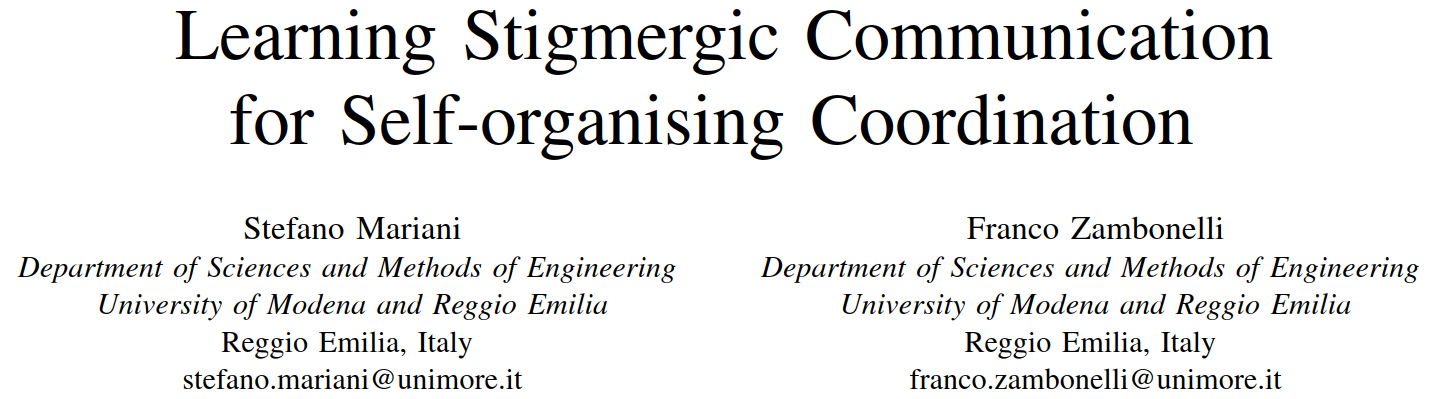
<p><img src="https://smarianimore.github.io/assets/acsos2023-rl-swarms-title.png" alt="image-center" class="align-center" /></p>

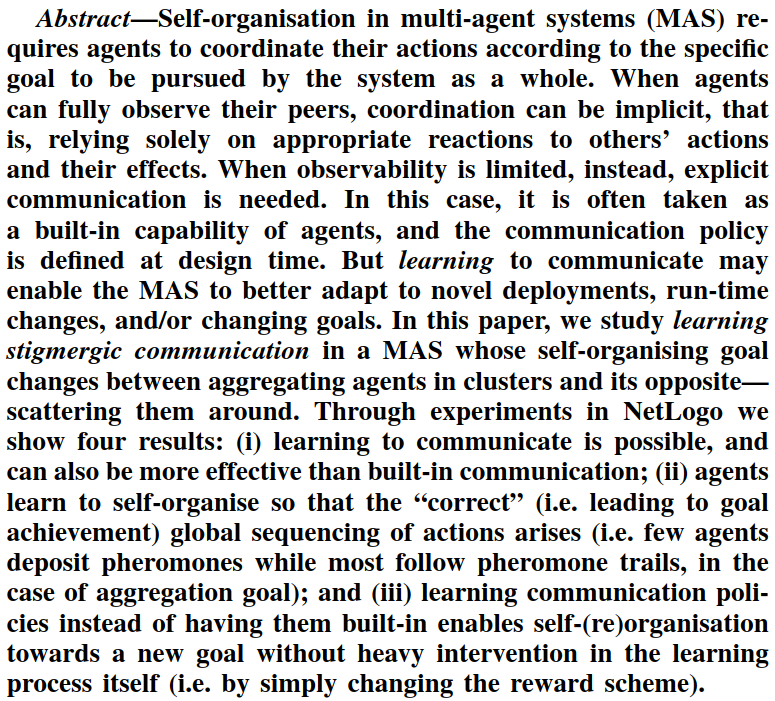
<p><img src="https://smarianimore.github.io/assets/acsos2023-rl-swarms-abstract.png" alt="image-center" class="align-center" /></p>

<p>I care about all of my papers (quite obviously), don’t get me wrong, but <strong>I care particularly about this one</strong> as it is quite a novel field of research for me, hence early feedback is extremely valuable (more than usual).</p>

<p>In brief, the paper proposes to <strong>learn communication policies</strong> amongst agents in a multi-agent systems to achieve self-organisation.
The study is motivated by the fact that bottom-up coordination strategies are difficult to design, are often tightly tailored to the goal to be achieved by the MAS, and the behaviour that the designer wants to inject in the system is often finely tuned to the specific problem at hand via extensive simulation sessions.
Having agents learn such strategies from scratch may free the designer from this burden, and also give <strong>greater adaptiveness</strong> to the resulting agents’ behaviours.</p>

<p>The learning environment is a simple yet expressive pheromone-based scenario: slime molds aggregation.
In a slime mold, different cells communicate the need for aggregation (e.g. to face danger) by locally depositing pheromone. 
Cells wander randomly but prefer areas with stronger pheromone scent—the pheromone evaporates over time.
In this way, clusters of slimes appear by emergence when needed, and disband when not needed anymore.</p>

<p>Our general goal specialised to this scenario becomes then to let the slime agents learn <strong>when</strong> (i.e. in what circumstances, in which system state) to deposit and follow pheromone to successfully cluster.</p>

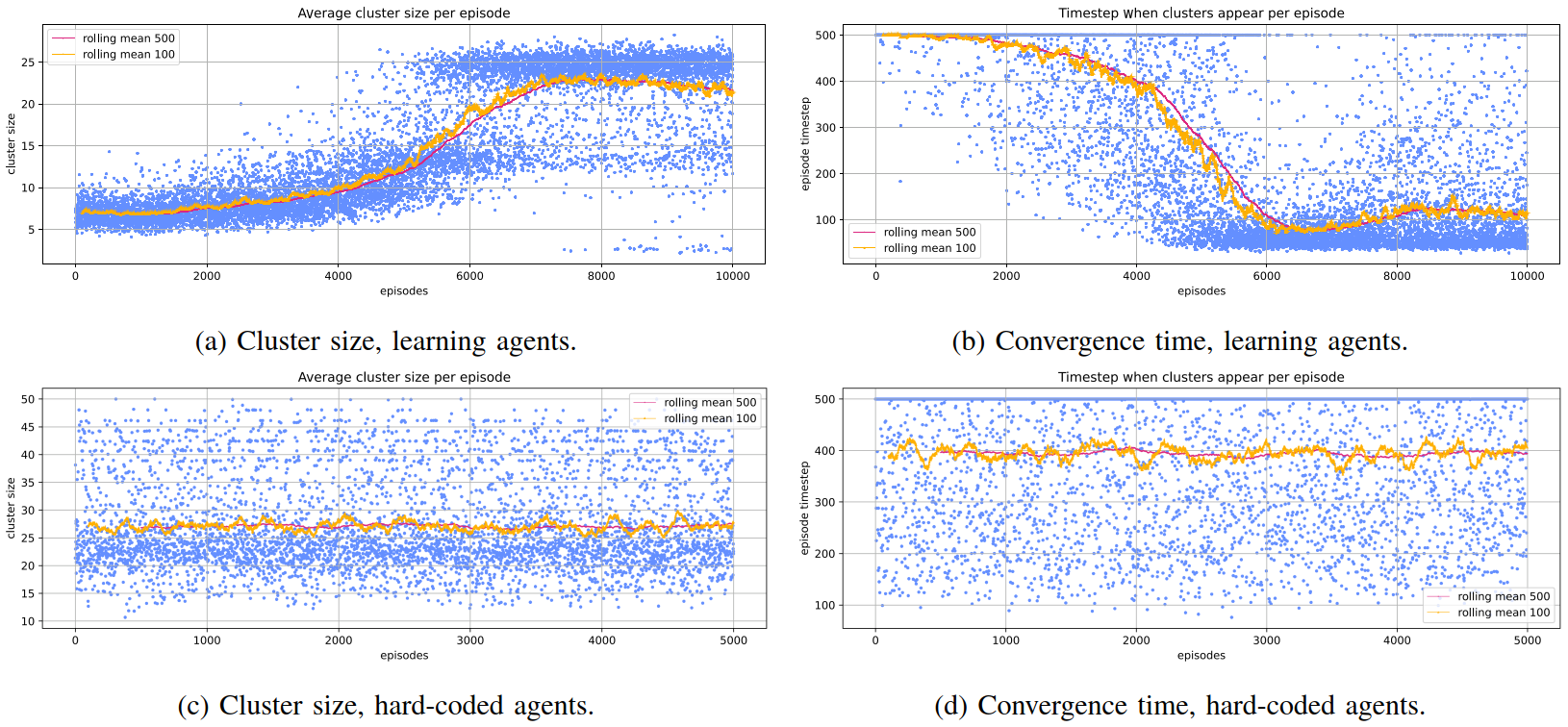
<p>The key results achieved are:</p>
<ul>
  <li><em>*independent learning</em> works (fully decentralised)</li>
  <li>learnt policies <strong>outperform</strong> the ones usually hard-coded</li>
  <li>learnt policies <strong>diverge</strong> despite agents’ homogeneity, and this is key to self-organisation</li>
  <li>learnt communication policies <em>*adapt</em> to changing goals (where the goal is the task to achieve by the MAS—the learning goal is fixed instead, of course)</li>
</ul>

<p>As pheromone-based communication (like other stigmergic communication mechanisms) is widely studied and used in both MAS and swarm robotics, this research line has potential impact in this application fields.</p>

<iframe width="560" height="315" src="https://www.youtube.com/embed/1qUBvnw3tbU?si=vtMuwMkdZYbRzMhf" title="YouTube video player" frameborder="0" allow="accelerometer; autoplay; clipboard-write; encrypted-media; gyroscope; picture-in-picture; web-share" allowfullscreen=""></iframe>

<p><img src="https://smarianimore.github.io/assets/acsos2023-rl-swarms-results.png" alt="image-center" class="align-center" /></p>

<p>Feel free to <a href="mailto:stefano.mariani@unimore.it">contact me</a> for a pre-print, any inquiry, or even better <strong>to join us</strong> in this research :)</p>

<p>Peace.</p>]]></content><author><name>Stefano Mariani</name></author><category term="ACSOS2023" /><category term="pheromone-based communication" /><category term="multi-agent reinforcement learning" /><category term="swarm intelligence" /><category term="learning to communicate" /><category term="coordination" /><category term="publication" /></entry><entry><title type="html">Peer review at its worst</title><link href="https://smarianimore.github.io/2023/07/24/review-rant.html" rel="alternate" type="text/html" title="Peer review at its worst" /><published>2023-07-24T00:00:00+02:00</published><updated>2023-07-24T00:00:00+02:00</updated><id>https://smarianimore.github.io/2023/07/24/review-rant</id><content type="html" xml:base="https://smarianimore.github.io/2023/07/24/review-rant.html"><![CDATA[<p><strong>As a researcher, your work is always subject to others’ scrutiny and judgement</strong>: 
during submission of a manuscript, to the reviewers, 
after publication (if it passes through) to virtually anyone working in your same field of study.
That’s how it works, 
it can be argued that it is what tells scientific papers apart from any other kind of publication, 
and you, as a researcher, are trained to deal with it.</p>

<p>You also quickly learn to deal with the frustration and psychological impact of <strong>a reject</strong>: 
it <strong>basically says “your current work does not deserve to be published”</strong>.
It may be because it is poorly written, poorly organised, 
or due to methodological errors, insufficient evaluation, bad experimental results, etc.</p>

<p>Whatever the reasons, 
<strong>it is in your best interest</strong>, as a researcher, 
<strong>to quickly learn how to interpret the rejection properly 
so as to be happy anyway</strong> (hence overcome frustration): 
your peers are telling you what is interesting and what’s not in your paper, 
what is correct or not, what is well described or not, and so on, 
while also giving you suggestions for improving it.
<em>For free</em>.
And, at least theoretically, 
those giving you advice are experts in the field, 
hence the go-to researchers you most likely look at as examples of scientific rigour and success.</p>

<p>However, this is the best case scenario.
In the worst case, 
a rejection may leave you with nothing but frustration and a feeling of disrespect of your own hard work.</p>

<p>In this post, unfortunately I want to tell you about the this latter case.</p>

<p>Here follows a screenshot of the meta-review I received for one of my papers:</p>

<p><img src="https://smarianimore.github.io/assets/bad-metareview.PNG" alt="no-alignment" /></p>

<p>A meta-review is (briefly and roughly) a summary of other reviews 
that a (usually) senior or expert researcher 
writes after a discussion phase 
in which all the reviewers try to achieve consensus about acceptance or rejection of a paper 
(or, at least, about strengths and weaknesses thereof).</p>

<p><strong>How would you interpret the “Reasons to reject” 
  (“A type of paper that was more commonly seen in the literature previously”)
?</strong>
I have no idea. 
It also doesn’t sound like a scientific motivation for rejection. 
It sounds instead very much as a post-hoc justification of an a-priori decision. 
<strong>Or the post-hoc excuse to reject a paper that doesn’t fit the acceptance threshold</strong> 
  (more on this later on).</p>

<p>The remainder of the meta-review is not much better.</p>

<p>Juts to clarify, for this specific submission <strong>we got 3 accept out of 3 reviews</strong>, 
and all the reviews are largely positive for the most part, 
with few remarks 
  (some also expressed in dubitative form by the reviewers themselves). 
However the meta-review completely ignores this, 
and quickly dismisses the manuscript with (quote): 
  “The Paper well-written, clearly motivated.”
as the “Reasons to accept”.</p>

<p>In particular, all of the following appreciations vanished 
  (actually there are more in the reviews, 
  but I focus on the ones more directly contradicting the luckluster meta-review):</p>

<ul>
  <li>{Novelty} Good: The paper makes non-trivial advances over the current state-of-the-art.</li>
  <li>{Impact} Good: The paper is likely to have high impact within a subfield of AI […]</li>
  <li>{Evaluation} Good: The experimental evaluation is adequate, and the results convincingly support the main claims.</li>
  <li>{Reasons to accept} The paper brings important, reproducible results that should be applicable to many other domains. This research has been well-planned and carried out.</li>
  <li>{Evaluation} Good: The experimental evaluation is adequate, and the results convincingly support the main claims.</li>
  <li>{Novelty} Good: The paper makes non-trivial advances over the current state-of-the-art.</li>
  <li>{Impact} Good: The paper is likely to have high impact within a subfield of AI […]</li>
  <li>{Evaluation} Excellent: The experimental evaluation is comprehensive and the results are compelling</li>
  <li>{Reasons to accept} […] it addresses an important topic directly related to the conference theme. The presented approach is technically sound and fairly evaluated.</li>
</ul>

<p>In addition, the less positive scores (that are anyway not negative) 
are all from the same reviewer, that self-assesed as the less confident one.</p>

<p>Receiving a reject despite 3 clear accepts is already frustrating, 
but <strong>it may happen in competitive conferences as weird as it sounds</strong> 
  (again, a matter of acceptance threshold). 
Also, such frustration <em>could</em> be quickly overcome 
by looking at the suggestions for improvement you got. 
It <em>could</em>, if you got some…
Without them, you are left with nothing but frustration, and disrespect.</p>

<p>I hope that none of you incur in a similar review ever, 
but if you do, here follows my advice to go past it quick, and mentally healthy:</p>

<ol>
  <li><strong>blame the (meta)reviewer, not your work</strong></li>
  <li><strong>blame the acceptance threshold, not your work</strong></li>
</ol>

<p>Blame the (meta, in this case) reviewer, 
as it is his/her work to scientifically critique your paper 
in a constructive way. 
<strong>Failing to do so is his/her problem, not yours.</strong></p>

<p>Blame the acceptance threshold 
as it is either a now obsolete legacy of the past 
or, worse, a clear sign of lazyness by the program committee of the conference.</p>

<p>This topic could require a post on its own, 
but let’s be quick here 
as I’m getting tired of writing (😉): 
<strong>the best conferences have low acceptance rates (let’s say &lt; 25%)</strong>.
This is a matter of fact (IJCAI, AAAI, etc.)</p>

<p>Upon this matter of fact, 
many conferences quickly and lazily find a way to try to become the next best conference 
by the following (methodologically wrong) logical implication: 
<strong>to be a best conference we must set our acceptance rate low</strong>.</p>

<p>Hence, the (poor?) meta-reviewer found him/her-self in the position of 
<strong>having to reject</strong> a paper because the acceptance threshold was already achieved.
That’s not science.</p>

<p>Peace.</p>]]></content><author><name>Stefano Mariani</name></author><category term="rant" /><category term="peer review" /></entry><entry><title type="html">PAAMS paper pdf available!</title><link href="https://smarianimore.github.io/2023/07/19/paams2023-update.html" rel="alternate" type="text/html" title="PAAMS paper pdf available!" /><published>2023-07-19T00:00:00+02:00</published><updated>2023-07-19T00:00:00+02:00</updated><id>https://smarianimore.github.io/2023/07/19/paams2023-update</id><content type="html" xml:base="https://smarianimore.github.io/2023/07/19/paams2023-update.html"><![CDATA[<p>As anticipated in a previous post, an extended version of our AMAAS 2023 abstract on <strong>multi-agent causal discovery</strong> has been accepted at PAAMS, and is now available online in the proceedings: 
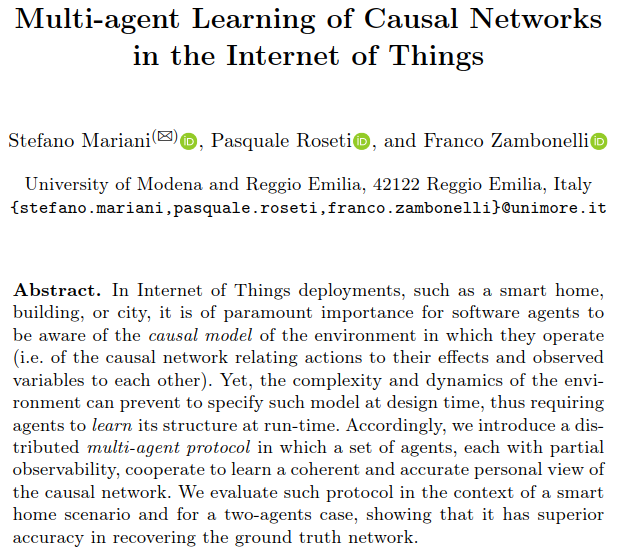
Kudos to the brilliant master student <a href="https://www.linkedin.com/in/pasquale-roseti-a5b513238/">Pasquale Roseti</a>, that co-authored with me and <a href="http://www.agentgroup.unimore.it/Zambonelli/">Franco Zambonelli</a> this novel version of his first scientific publication :)</p>

<p><img src="https://smarianimore.github.io/assets/2023-paams-causal.png" alt="no-alignment" /></p>

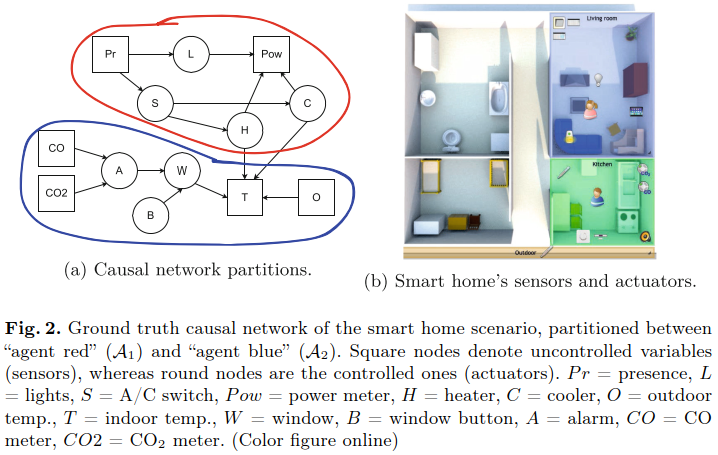
<p>In brief, the paper proposes a <em>multi-agent protocol</em> to collaboratively <strong>discover (= learn) the causal structure</strong> relating variables of interest (e.g. sensors and actuators) in a distributed network.
The study is motivated by the fact that learning not only <em>correlations</em> amongst variables (as classical statistical ML does) but actual causal relations (as per level 2 of <a href="http://lgmoneda.github.io/2018/06/01/the-book-of-why.html">Pearl’s ladder of causation</a>) is crucial to let agents proficiently understand situations and plan accordingly how to achieve their goals in unknown environments, also favouring <em>explainability</em> of decisions taken by AI.</p>

<p>Evaluation of the protocol has been carried out in a simulated smart home environment.</p>

<p><img src="https://smarianimore.github.io/assets/2023-paams-causal-scenario.png" alt="no-alignment" /></p>

<p>The key results achieved are:</p>
<ul>
  <li>learning <strong>accuracy is always better</strong> with multi-agent learning than with single-agent learning</li>
  <li>learning <strong>performance is always better</strong> in the multi-agent case, too, to an extent increasing as the causal network size and complexity increases (e.g. number of edges and indirect causal paths length)</li>
</ul>

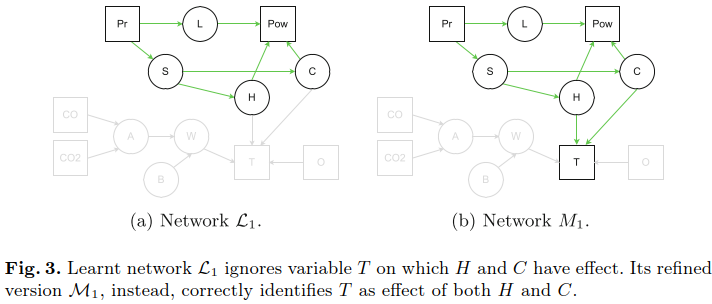
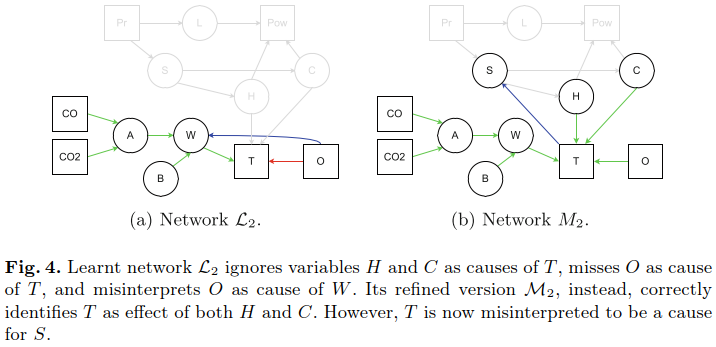
<p>The core idea of the approach is to leverage any existing causal discovery algorithm locally to each agent, then refine the locally learnt model by <strong>coordinating interventions</strong> with other agents sharing the environment, even when no overlap exists amongst the set of known variables.
In this way, both the agent requesting help (e.g. $A_1$, agent red) and the one giving help (e.g. $A_2$, agent blue) can improve their local model!</p>

<p><img src="https://smarianimore.github.io/assets/2023-paams-causal-agent1.png" alt="no-alignment" /></p>

<p><img src="https://smarianimore.github.io/assets/2023-paams-causal-agent2.png" alt="no-alignment" /></p>

<p>Feel free to <a href="mailto:stefano.mariani@unimore.it">contact me</a> for a pre-print or any further inquiry :)</p>

<p>Peace.</p>]]></content><author><name>Stefano Mariani</name></author><category term="student" /><category term="PAAMS2023" /><category term="causal discovery" /><category term="multi-agent causal learning" /><category term="smart home" /><category term="coordination" /><category term="publication" /></entry></feed>